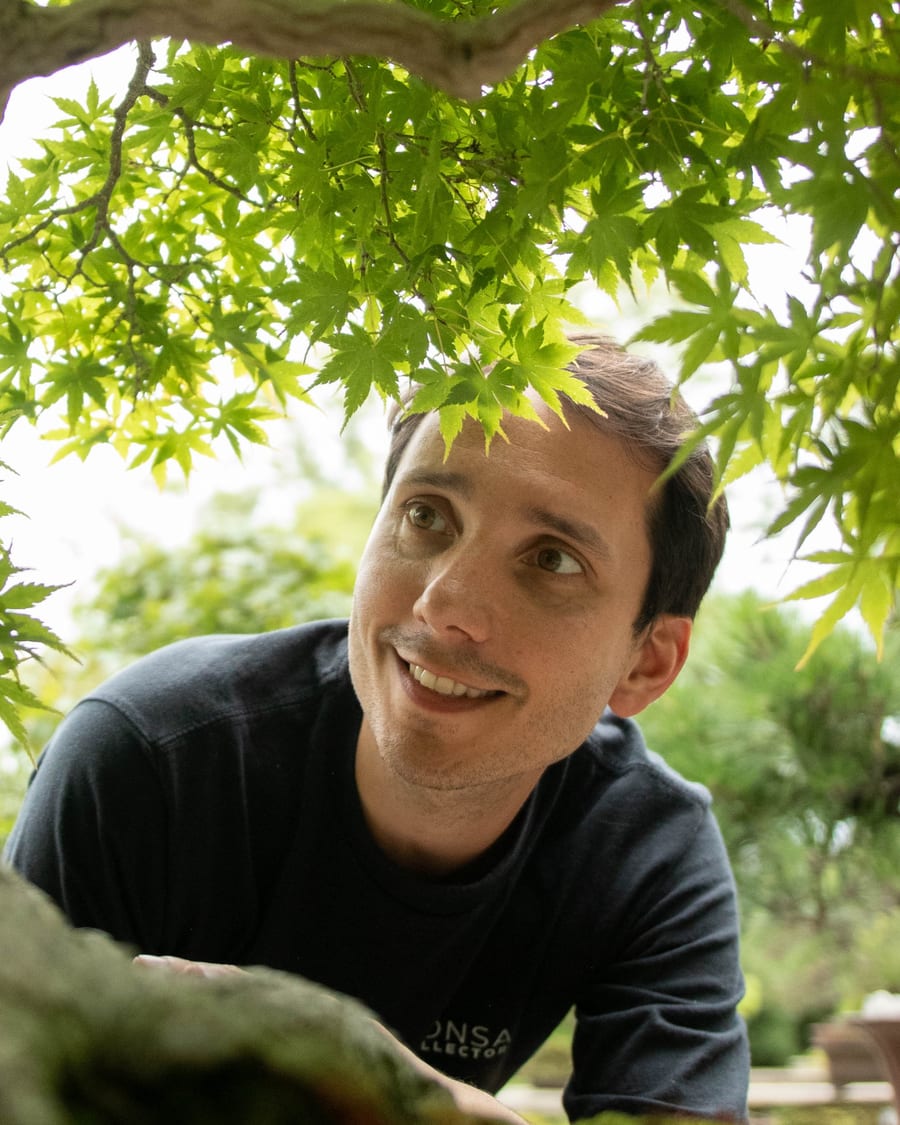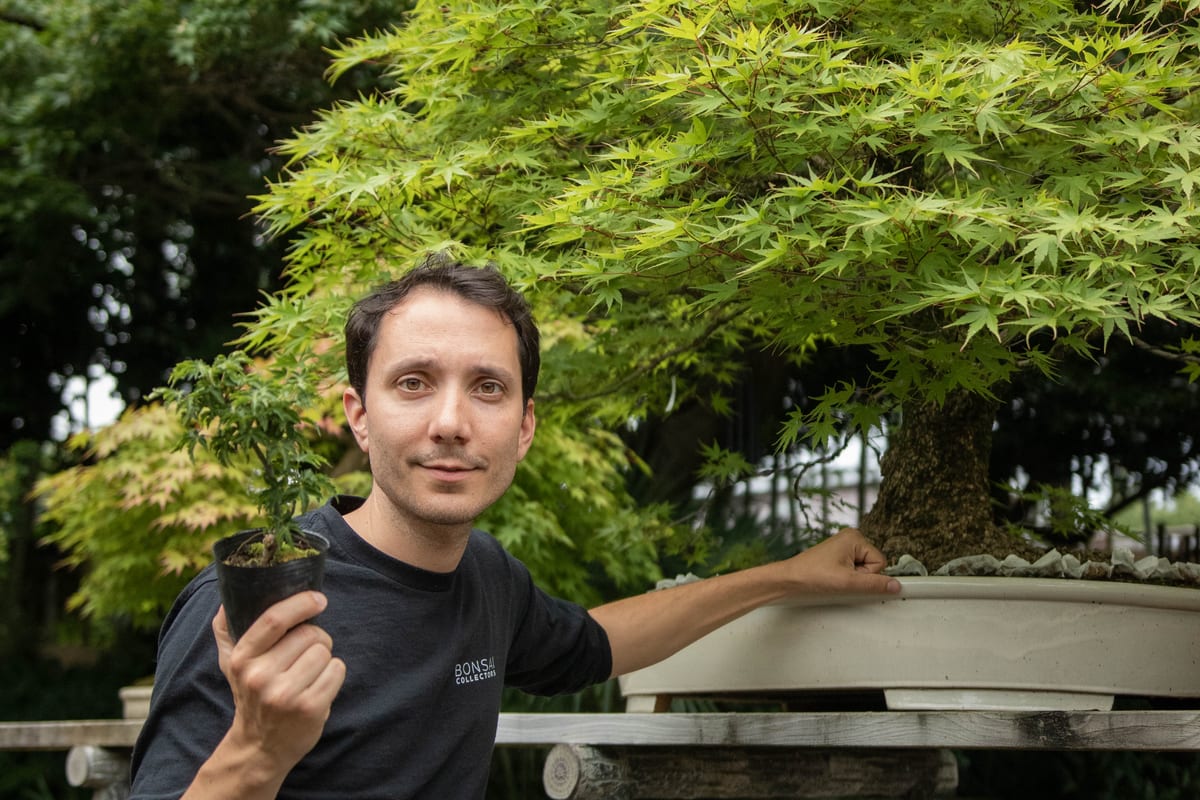
How I got into bonsai
Through my mother. She already had a collection when I was a kid, first in Paris, then at our house with a garden south of the city. It was her passion, not mine. For me it was mostly a chore: when Mum's away, someone has to water the trees.
I moved to Japan in September 2014 for work. I'd already studied there for six months in 2010 and 2011, and went home to France after the earthquake. In 2015 my mother came to visit. We're in Japan, so I need a bonsai: she bought me one.
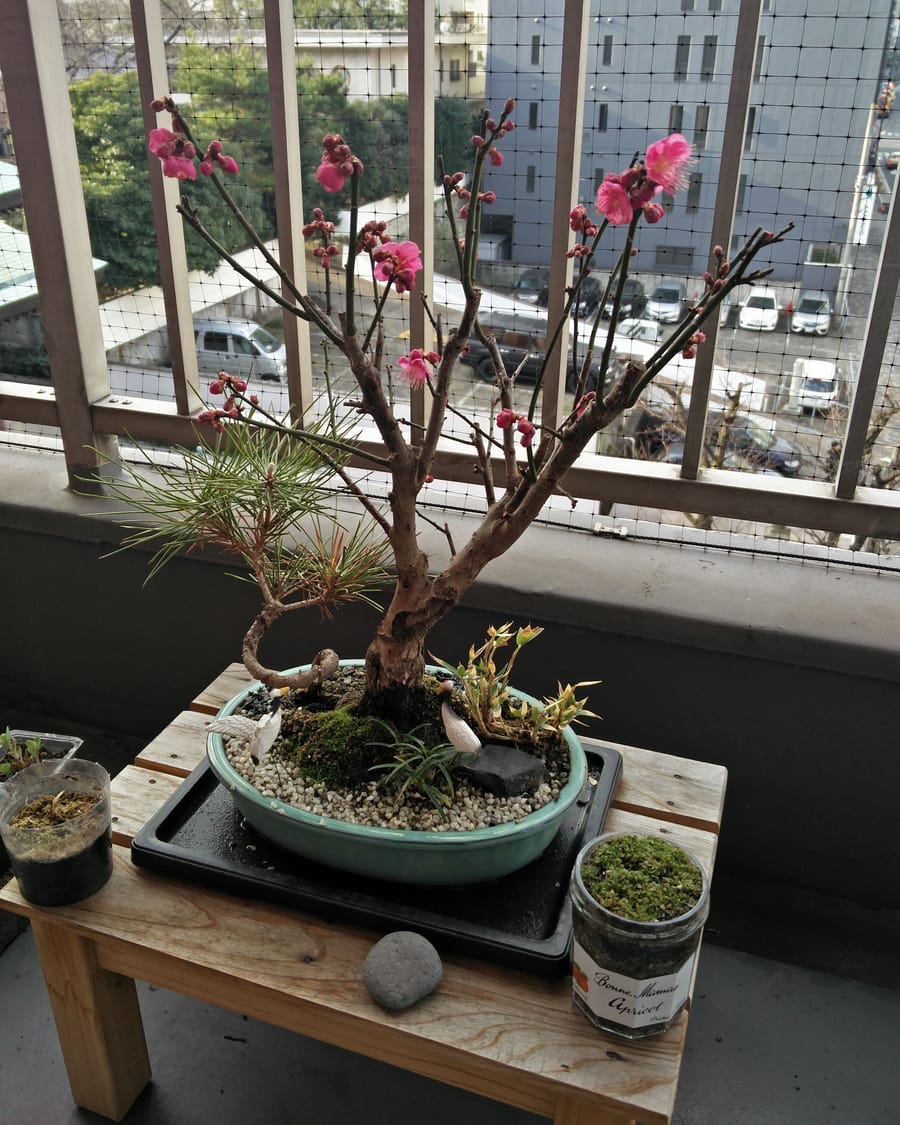
Not at a famous nursery. In the garden section of the local DIY store. In Japan you find bonsai almost everywhere, especially at the end of the year, when people give them as gifts. It was a shochiku-bai, a New Year arrangement: a big flowering plum, a small pine, and a bamboo that wasn't bamboo at all. It was an asparagus fern.
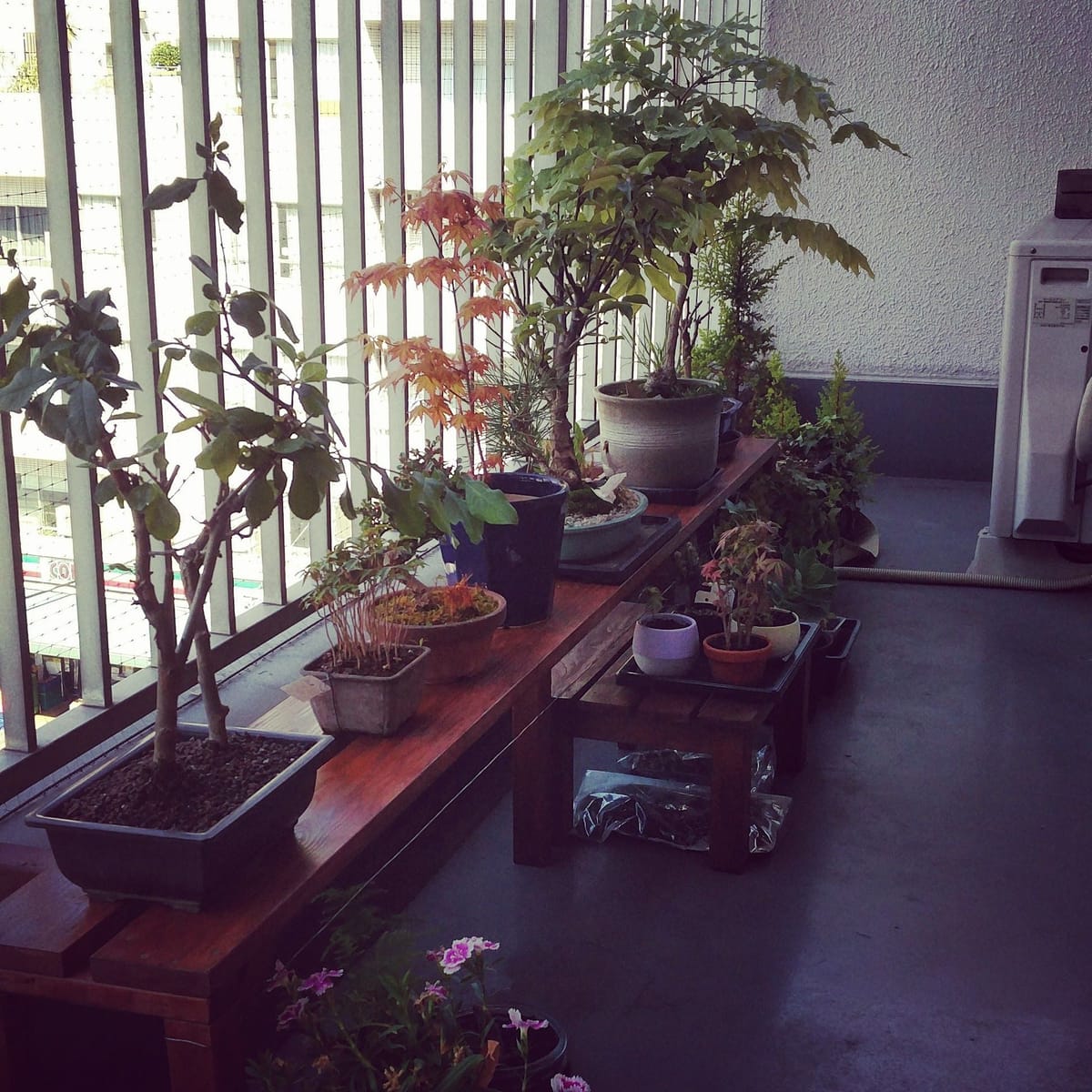
A few years later I split it into three pots, because the three plants don't want the same things. That took me a while to learn. By then I'd filled my balcony, and then the small garden of our house in Tokyo.
The Monsieur Bonsaï YouTube channel
I started the channel in 2015. I was learning from books in French, English and Japanese, and pretty soon I wanted to see things, not just read about them. I was too shy to knock on a master's door, so I went to YouTube, and I couldn't find anything good. So I filmed it myself, to learn and to share.
The basics first: soils, moss, small arrangements. Never my face, just my hands and the trees. What people want to see is how it's done, not someone talking to a camera. I spent weeks editing so it looked right.
What grew the channel was the exhibitions: the Kokufu-ten, the Taikan-ten, the shohin shows in Ueno. Trees you couldn't see from outside Japan. Those videos are still online, people still watch them, and they still bring them up with me today.
My guide to the Kokufu-ten, and how I got a press pass there
How I met Adam Jones
At the Kokufu-ten. Professionals exhibit their clients' trees, and their apprentices keep the show running. Among them I met two foreigners doing their apprenticeship: Bjorn Bjorholm, then in Osaka, and Adam Jones. I was making videos, so I gave them my card.
In 2018 Adam finished his apprenticeship and bought his land. He messaged everyone in his contacts: come and see me, I'm opening my garden. I went. I took lessons with him, we filmed together, we became friends, and I kept coming back, more and more often, to help the garden grow.
Then, after Covid and a change in my working life, Adam asked me to join him as a partner, on the business side. That's how I went from amateur to professional, at Tree House Bonsai. The whole story comes down to a business card.
What a professional garden teaches you
At first it was just the two of us, Adam and me. There was a business to put in order, and there was the garden. With that many trees, everyone pitches in. So mostly, I watered.
In summer that's a full day. About 2,000 trees, two people, and temperatures up to 40°C. You start early, while it's still cool. The first round takes over two hours, and as soon as it's done, you start again. Two or three rounds a day. In winter you walk past every tree, one by one, and water only the ones that need it.
It's the hardest part, and it's the first thing you learn, amateur or pro: learning to water. There's no way around it. You have to put in the seasons.
When apprentices started arriving to study under Adam, I gave them my place in the garden. Today I work full time on the business: export, trips, and organizing masterclasses and visits.
Behind the curtain
When you're part of a professional garden, you're part of the trade's events: preparing exhibitions, and the auctions that are open only to professionals. You go behind the curtain.
At the auctions, everyone unloads their own trucks. One team brings the trees to the conveyor belt, in front of the auctioneer. At the other end, a second team takes them off and sorts them by buyer number. I was often on that second team. The older ones sit, buy and sell. The young ones carry. It's physical, you handle every tree, and that's where I got to know people my own age in the trade.
At first, a lot of people thought I was an apprentice. After explaining again and again that I was Adam's business partner, most of them got it, and accepted me as a professional in my own right. What counted was proving it, year after year.
Show that you're here for the long haul, that you gambaru. When you're a foreigner, you have to show it twice.
Gambaru (頑張る): to hold on, to persevere, to give everything without letting go.
How trust gets built with a Japanese grower
Business is business. In Japan, bonsai is a trade, and an industry. Trust isn't declared. It builds up, by coming back.
For example, I brought groups of clients to Kunio Kobayashi's Shunka-en museum several months running, several years running. It shows him we have clients, that we bring them to him, and that we chose his garden over someone else's. It's the same with the growers we visit every year with our trade clients, without ever skipping a year.
Nothing is written down. It's a relationship built on gentleman's agreements. Even today, being accepted in a purely Japanese industry when you're not Japanese is a daily challenge.
What the trees gave me
In 2020, during Covid, I went through a very, very stressful period at work. My stomach hurt all the time. I think it was the start of an ulcer.
We lived in Tokyo, in a house with a small garden. My trees sat on a three-tier bench I'd built myself. I could see them from the living room window. I'd go out to look at them. And when I focused on them, on what they needed, on where I wanted to take them, the pain went away.
It became a reflex. Whenever the stress built up, I thought about the trees. I wouldn't say bonsai saved me. But it helped me keep my head above water.
Why I came back to France
The planets lined up. Europe is our biggest export market, and to grow there you have to be there: in the right time zone, close to clients. And for our family, it made sense to come home at that point.
I came back in 2025. I go back to Japan several times a year, and every time, I lend a hand at an exhibition.
What I do today
I carry on with what I was already doing in Japan: I take enthusiasts, collectors and clubs into gardens, nurseries and exhibitions. I know the people, the places, and how to read an exhibition.
When a tree is worth bringing home, we handle it: Tree House Bonsai exports it from Japan, and Bonsai Collectors, my company in France, imports it.
And in France, I brought a collective of professionals together under the Monsieur Bonsaï name, JP Hoareau, Alexandre Gsell and Martin Tachon, so the trees are cared for, boarded and looked after once they arrive.
What I'm not
I'm not a bonsai master. I didn't do the traditional Japanese apprenticeship, which takes five years or more. I studied with masters, mostly with Adam, and I spent years with my hands in the soil in a professional garden. But that doesn't make me a master, and it's not what I want to be.
I'm the other half of a master. I know the bonsai business, import, export, the people in the trade. I know the trees, the species and how to care for them, and I can do the work myself when it's needed.