
Bonsai in Japan
Bringing a bonsai home from Japan: what's possible
Yes, you can bring a Japanese bonsai into Europe, but not in your suitcase, and not straight away. The tree first has to spend two years in a registered, inspected nursery in Japan, then travel with a phytosanitary certificate and pass a border check. From falling for a tree to having it at home, allow about two years.
Adrien Pichon · Bonsai professional · Ten years in Japan
Published 12 September 2026
Can I bring a bonsai home from Japan in my suitcase?
No. Every year, at the big sale held during the Kokufu-ten, I watch visitors buy a tree, slip it into their suitcase and fly home with it. They don’t know what they’re doing, and I don’t hold it against them. But it’s illegal, and it’s a risk, for the tree and for our forests.
Since 14 December 2019, every plant for planting that enters the European Union needs a phytosanitary certificate, a declaration and a border check. The luggage exemption only covers plants that aren’t for planting, like some fruit. A plant that arrives without its papers is seized and destroyed, as French customs points out (in French).
And for a bonsai, a certificate isn’t enough: the tree must have spent two years in a registered, inspected nursery in Japan. A traveller can’t do that themselves.
Then there’s the tree itself. Checked luggage gets thrown around. To keep a branch from snapping and the pot in one piece, you’d need a frame inside something the size of a cabin bag. Putting a tree in there is exposing it to certain damage.
Why can’t a tree travel like a souvenir?
Because of what it can carry without anyone seeing. The best-known case is the Asian longhorn beetles: big insects with long antennae that live in wood.
The female lays her eggs under the bark. The larva tunnels through the wood for months, and that’s what does the damage. You can’t see it while it’s inside the wood. The adult comes out through a perfectly round hole, 10 to 15 mm across. By then, it’s too late.
In Japan I see them in a lot of gardens. Planted trees, niwaki, carry these holes: they live with the pest. I’ve also seen bonsai with them, and people working hard to save those trees, filling and hiding the holes and hoping the tree pulls through. Some lose branches. Some die.
In Europe, the Asian longhorn beetle and the citrus longhorn beetle are among the most closely watched pests. The citrus longhorn beetle has already been introduced in France, which has only been free of it again since early 2024, according to the French Ministry of Agriculture (in French). And it isn’t only insects: there are nematodes in the soil too, and diseases like certain rusts.
This isn’t just a trade issue. It’s a plant health issue, for every country. That’s what quarantine rules are for.
Which bonsai can be imported from Japan?
Many, but not all, and each on its own terms. Here’s what the EU texts say as of September 2026.
Banned: Prunus, meaning cherries, plums and Japanese apricot (ume). Apples, pears and quinces too. And in principle, the big conifers: pines, spruces, larches, cedars and firs, as well as junipers and Chamaecyparis.
Allowed anyway, by exemption, until 31 December 2028: junipers, Chamaecyparis (including hinoki), Japanese white pine and Japanese black pine, including when grafted onto another pine. Japanese red pine isn’t included. After 2028, it all depends on whether the EU extends the exemption.
Allowed under conditions: most deciduous trees, such as maples, elms, hornbeams, beeches and zelkovas, and satsuki azaleas. For species the longhorn beetle attacks, like maples and elms, the nursery must keep the trees under netting for the whole quarantine. A few genera, such as hawthorns, flowering quinces and roses, can only enter dormant, with no leaves, flowers or fruit.
These rules come from Implementing Regulation (EU) 2019/2072, Annexes VI and VII, and Implementing Regulation (EU) 2024/2852 for the conifers. They change: before you buy, ask your importer what applies to your tree.
How does quarantine work in Japan?
A tree bound for Europe first has to enter a traceability system. The grower registers the nursery with the Plant Protection Station, the plant health service of Japan’s Ministry of Agriculture. The application is due by 31 March, and the tree enters quarantine in April.
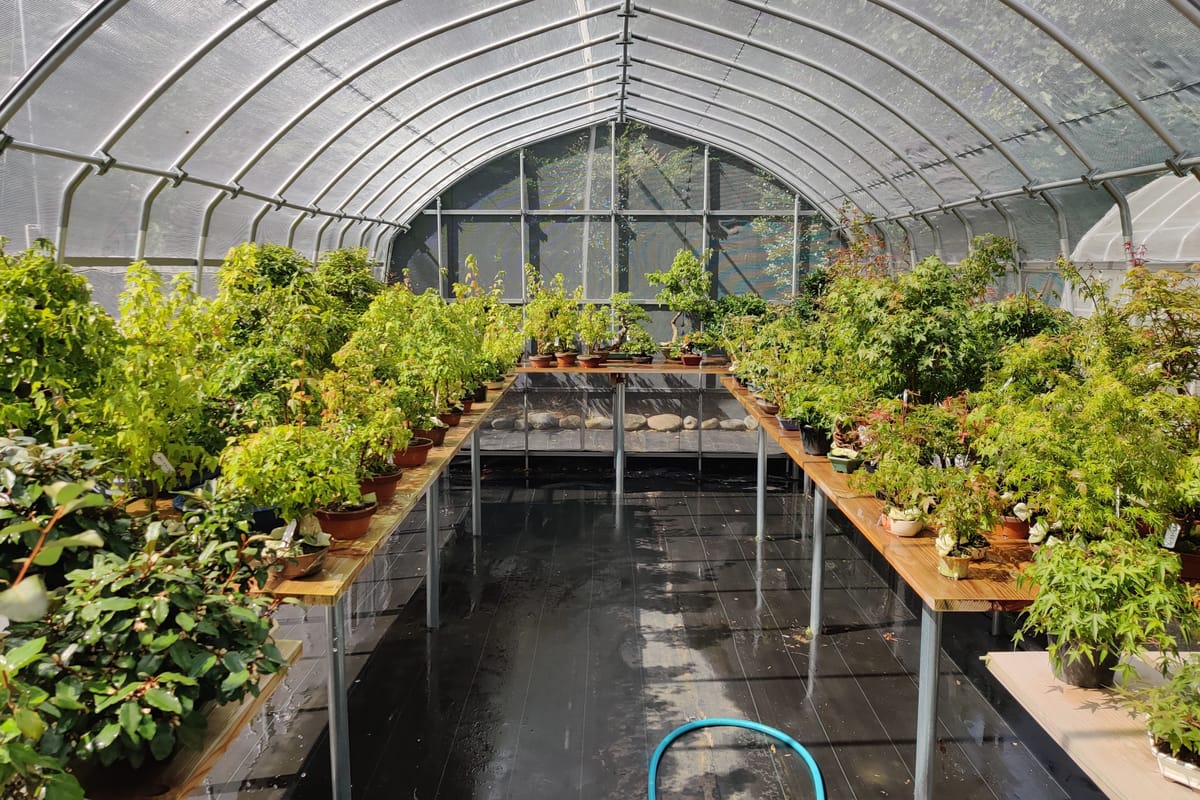
The tree then has to stay at least two consecutive years in that registered nursery. The EU requires at least six official inspections a year. In Japan, they take place every month during the season, starting in April.
During those two years:
- pots sit on shelves at least 50 cm off the ground, or on a concrete floor for the exempted conifers, so no nematode can climb up from the soil;
- the trees get a fungicide treatment against rusts, which is then recorded on the phytosanitary certificate;
- species the longhorn beetle attacks stay under netting;
- in the two weeks before departure, the soil is washed off or treated.
Depending on the species, the tree stays in a closed greenhouse or outdoors. The whole time, it lives its life as a tree, with the risks any tree faces, but in professional hands. The products used get rid of the targeted pests and diseases without harming the tree.
Why do trees ship in winter?
Because a tree handles the journey best while it’s dormant. Japan requires deciduous trees to be exported leafless, during dormancy. On the European side, junipers can only enter from 1 November to 31 March. Pines and Chamaecyparis could legally enter all year, but in our practice, everything ships in winter.
By sea, in a container, it takes about three months door to door. The trees travel in refrigerated, ventilated containers, each pot prepared so the roots don’t dry out. Dormant, the tree barely drinks and stops photosynthesizing: it waits. By air, in a crate, it’s faster.
How long does it take to import a bonsai from Japan?
It depends on the tree you choose.
If it has already done its two years of quarantine in a registered nursery, it can leave the following winter, with its phytosanitary certificate. That takes a few months.
If it isn’t in quarantine, it has to do it. Say you fall for a tree in November 2026. The paperwork is done in February and March 2027, the tree enters quarantine in April 2027, and it spends two seasons there, 2027 and 2028. It can leave in the autumn of 2028 and reaches France in early 2029. So about two years. For a conifer, add the quarantine on arrival, which runs until the end of June for a juniper.
What happens when the tree arrives in the EU?
A tree can’t just walk in. In France, where we import, the importer needs an EORI number for customs and must be registered as a professional plant operator with the regional food service (SRAL) of the DRAAF. Every shipment is declared in advance in the EU’s TRACES system. On arrival, the tree goes through documentary and physical checks at a border control post before it can enter.
The exempted conifers then stay in official quarantine. Pines and Chamaecyparis for at least three months of active growth. Junipers from 1 April to 30 June. So a juniper that arrives in January comes out in July.
After that, the tree has to adapt to a new climate, new water, new light. The first months matter. That’s why the Monsieur Bonsaï collective receives it, sees it through its spring restart, and either boards it or delivers it to your home.
Who does what?
Bringing a tree over is a chain, and every link counts.
In Japan, Tree House Bonsai, the garden I’m a partner in, puts the tree into quarantine, looks after it for two years and exports it. In France, Bonsai Collectors, my company, is the importer: it declares the arrival, handles the border check and answers for traceability. Then the collective takes over.
How much does it cost to import a bonsai from Japan?
I don’t publish a price list, because it wouldn’t mean anything. A tree travelling in a container with others, in a trade shipment, doesn’t cost the same as a single tree in a crate by air. The tree’s size, value and species change the numbers too.
What I do is give you the full cost before you decide: the tree, the quarantine, the shipping and the import.
Can I buy directly from a Japanese grower?
Yes, if you have someone with you who introduces you to the grower, collects the tree, puts it into quarantine and runs the whole process.
When you buy a tree in Japan, you’re agreeing to become part of a chain of expertise, and every link in it matters. Trying to skip one to save time or money always ends up costing the tree.
Should this tree really leave Japan?
It’s a real question, and it doesn’t depend on the species. It depends on the tree.
A tree that leaves Japan practically never goes back. Japan bans soil and plants carrying soil, and its rules are so strict that a return trip would put the tree at risk. Sending a tree out of Japan means it leaves Japan for good.
Some trees have grown for decades, sometimes centuries, in the hands of Japanese masters, in their climate. Everyone is an expert in their own climate. In Europe, the tree will have to adapt, and it will need someone who knows its new climate. Whoever imports a tree like that takes on a real responsibility, and needs to own it before deciding.
The day the doors open
After three months in the dark and the cold, the container doors open. The tree sees light again. A few weeks later the buds swell and the sap starts moving. It left Japan alive and healthy. It arrives in Europe alive and healthy. That’s all that matters.
Official texts
- Regulation (EU) 2016/2031 on protective measures against pests of plants.
- Implementing Regulation (EU) 2019/2072, Annexes VI (prohibited plants) and VII (special requirements, including naturally or artificially dwarfed plants).
- Implementing Regulation (EU) 2024/2852, the exemption for dwarfed junipers, Chamaecyparis and pines from Japan.
- Importing plants and plant products, French customs (in French).
Questions
- Can I bring a bonsai home from Japan in my suitcase?
- No. Since 14 December 2019, every plant for planting entering the European Union needs a phytosanitary certificate and a border check. Otherwise it's seized and destroyed. A bonsai must also have spent two years in an inspected nursery in Japan.
- How long does it take to import a bonsai from Japan?
- About two years if the tree isn't already in quarantine in Japan. Only a few months if it has already done its two years in a registered nursery.
- Which bonsai can be imported from Japan into the EU?
- Most deciduous trees, such as maples, elms and satsuki azaleas, under conditions. Cherries, plums and apples are banned. Among conifers, only junipers, Chamaecyparis, Japanese white pine and Japanese black pine can enter, under an exemption valid until 31 December 2028.
- How much does it cost to import a bonsai from Japan?
- It depends on the shipment. A single tree in a crate by air doesn't cost the same as a tree travelling in a container with others. Every project gets its own quote.
- Can I buy a bonsai directly from a Japanese grower?
- Yes, with someone who introduces you to the grower, collects the tree, puts it into quarantine and organizes the export.
- Can a bonsai be sent back to Japan?
- It's very difficult: Japan bans soil and plants carrying soil. A tree that leaves Japan practically never goes back.