
Bonsai in Japan
Omiya, the bonsai village
Omiya is Japan's bonsai village, founded in 1925 north of Tokyo after the Great Kantō Earthquake of 1923. Six historic gardens remain, free and closed on Thursdays, along with the Omiya Bonsai Art Museum, five minutes' walk from Tōro station. Allow half a day, and remember you're looking at the very top of the craft.
Adrien Pichon · Bonsai professional · Ten years in Japan
Published 14 September 2026
What is the Omiya Bonsai Village?
After the Great Kantō Earthquake of 1923, bonsai and chrysanthemum growers left Tokyo to settle further north, in Omiya, now part of Saitama city. They were looking for space, clean water and fresh air. The bonsai village was founded in 1925, and it celebrated its hundredth anniversary in 2025.
At one point it had around thirty gardens. Over the years the city grew up around it, and today six remain, run by families for several generations.
Omiya is one of the cradles of modern bonsai. The Mecca of bonsai, for the whole world.
My first time in Omiya
It was winter 2015. I went on my own, with no one rushing me. I started with the museum, then wandered the village streets looking for the gardens open to the public.
It was exhilarating, and a bit overwhelming. First, you’re not sure whether you’re allowed in. And when you do go in, you find places full of masterpieces. You see everything and nothing at the same time, there are so many trees of such high quality.
After the museum, I went into Mansei-en. You squeeze sideways between benches covered in trees, with no room to step back, taking care not to touch a single branch. No one to guide you, no photos. You know everything is precious, because it’s one of the oldest gardens in the village, but it’s hard to really look. You get lost among the rows, and then you come across something incredible.
That was my pure beginner’s eye. With a few years of bonsai behind me, I wouldn’t have seen things the same way.
Which gardens should I visit in Omiya?
The village’s six gardens, according to Omiya’s official site:
- Mansei-en, one of the oldest and best known;
- Seikō-en;
- Tōju-en;
- Fuyō-en;
- Kyūka-en;
- Shōsetsu-en, opened in 1977, a little apart from the heart of the village.
They’re free. These are working gardens, open every day in theory. But they close on Thursdays, and sometimes on other days without notice, when nobody is there to receive visitors. When I take a group, I check on the day which ones are open.
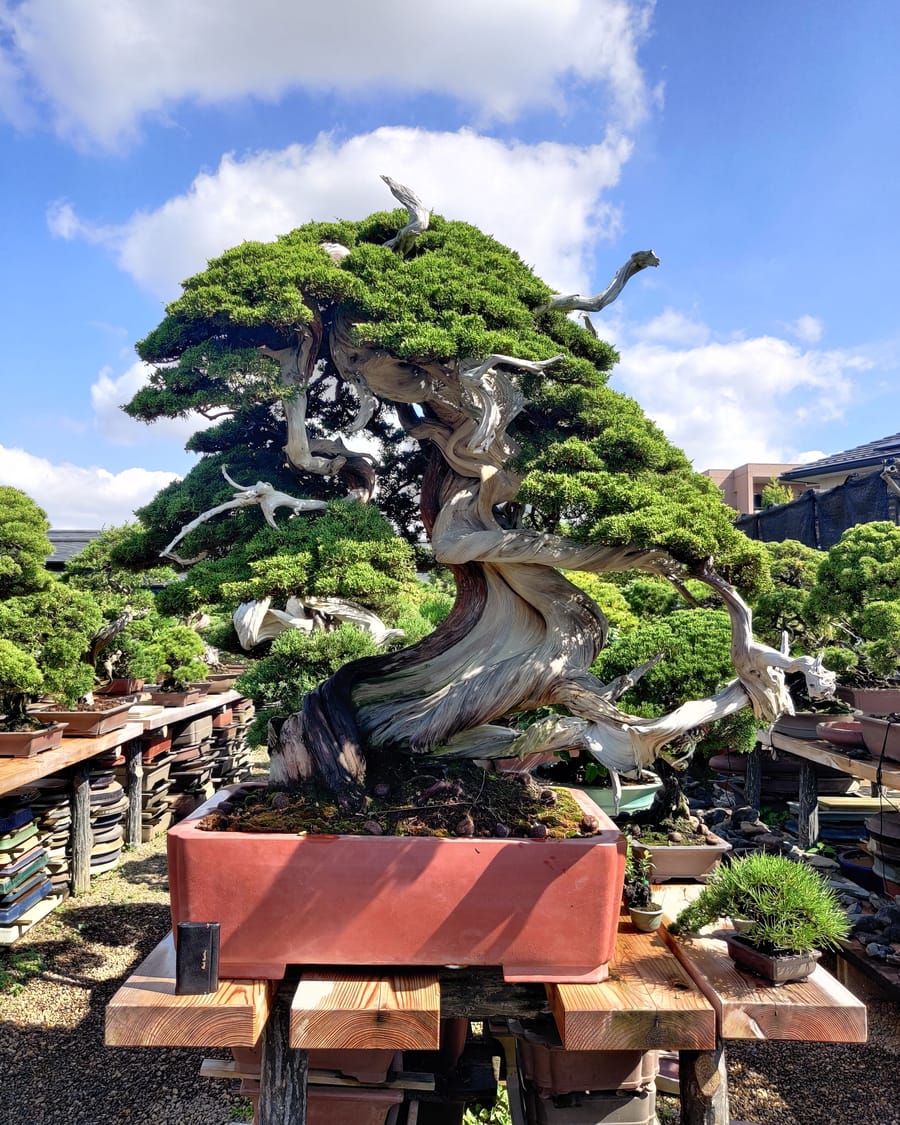
A tip for Mansei-en: just to the right of the entrance, in a very crowded spot, stands Hiryu, a juniper the garden says is over a thousand years old. People now say 1,200. It’s one of the most famous bonsai in the world. Most visitors walk straight past it. If nobody points it out, you’ll miss it.
Is the Omiya Bonsai Art Museum worth visiting?
Yes. Its collection is one of the finest there is. Only part of the museum’s trees is on display: as in every garden, there’s a visible part and a hidden part. Behind the scenes are trees that aren’t ready to be shown, some sick, others being developed or resting. It’s the workshop, and it’s also what lets the museum rotate trees, so returning visitors don’t always see the same thing.
The museum’s garden has been renovated, with its pond at the centre of the courtyard, and it reopened in March 2025. It was already a beautiful place. It’s even more so now.
According to the museum, it’s open from 9:00 to 16:30 from March to October, and from 9:00 to 16:00 from November to February, with last entry thirty minutes before closing. It’s closed on Thursdays, unless it’s a public holiday, and from December 29 to January 3. Adult admission is ¥310. Since September 4, 2026, photography is allowed everywhere, without flash, tripod or selfie stick, keeping 30 cm from the trees.
How do I get to Omiya from Tokyo?
By train, in under an hour from Tokyo. Get off at Tōro station on the JR Utsunomiya Line: the museum is a five-minute walk, and it’s more convenient than Ōmiya-kōen station on the Tobu line, ten minutes away. After that, everything is on foot.
Allow two to three hours for the museum and the gardens. Half a day for a proper visit.
Etiquette in the gardens
Make yourself seen before going in. There’s no doorbell. When a garden looks open, try to catch someone’s eye, make a little noise so they know you’re there, and politely ask permission to look around.
Never touch the trees. Lean in carefully, and move around paying close attention to the branches around you: it’s very dense.
Don’t take photos without asking. In the gardens, always ask the owner’s permission.
Only ask a price if you’re ready to buy. In Japan, asking the price shows you’re serious. If you don’t intend to buy, don’t ask. And there’s no haggling: for a single tree, especially as a new customer, you pay the price asked. When I’m with you, I can ask for you and act as the go-between. But curiosity is one thing. Don’t pester people with a thousand prices when you have no intention of buying.
What Omiya shows, and what it doesn’t
In Omiya you’re at the very top of the craft. These are mostly gardens of mature, very high-quality trees, with collections built over generations. You go there to see the most beautiful, the most accomplished work.
What you won’t find is nursery stock, entry-level and mid-range trees, apart from a few small ones. For that, the nearest place is Fukaya, a little further on, about an hour and twenty minutes from Tokyo.
On your own, or with a guide?
A visitor on their own will see almost everything I could show them. The difference is that they can’t ask questions, or get answers about what they’re seeing.
I know the trade, the setting and the people. I can explain, tell the stories, and give substance to a visit that stays a bit dry when you don’t know what you’re looking at. Hiryu, the juniper at the entrance to Mansei-en, is the best example.
Can I buy a bonsai in Omiya?
Yes, but here’s what to know. From what I see, few Omiya gardens have their own quarantine system for export. A tree bought there usually has to be handed to an export professional to do its quarantine. So you’re committing to about two years before the tree reaches Europe. The whole process is explained here.
When should I go to Omiya?
No season is more beautiful than another. Every season has its trees, as everywhere in Japan.
One special time, though: every year, from May 3 to 5, the village holds its big bonsai festival, the Dai-Bonsai Matsuri, with trees and plants for sale in the streets, advice, and an exhibition.
Questions
- How do I get to the Omiya Bonsai Village from Tokyo?
- By train, in under an hour from Tokyo. Get off at Tōro station on the JR Utsunomiya Line: the museum is a five-minute walk. Ōmiya-kōen station, on the Tobu line, is ten minutes away.
- Do the Omiya gardens charge an entry fee?
- No, the six gardens are free. They close on Thursdays, and sometimes on other days without notice, when nobody is there to receive visitors. The museum costs ¥310.
- Can I take photos in Omiya?
- At the museum, yes, since September 4, 2026, without flash, tripod or selfie stick. In the gardens, always ask the owner first.
- How long does it take to visit Omiya?
- Two to three hours for the museum and the gardens. Half a day for a proper visit.
- Can I buy a bonsai in Omiya and take it home to Europe?
- You can buy, but the tree usually has to be handed to an export professional to do its quarantine. Allow about two years before it reaches Europe.