
Keeping it alive
There's no such thing as an indoor bonsai (almost)
Every tree is an outdoor tree. What Europe calls an indoor bonsai is a tropical tree, like a ficus, that copes with our homes. A Japanese bonsai lives outside: you can bring it in to enjoy it, but never for more than two weeks in a row.
Adrien Pichon · Bonsai professional · Ten years in Japan
Published 14 September 2026
Does the indoor bonsai really exist?
Saying there’s no such thing as an indoor bonsai is a bit of purist bravado on my part. I’m actually the first to avoid being too much of a purist. But at heart it’s true: every tree is an outdoor tree, whether it’s in a pot or in the ground.
What Europe calls an indoor bonsai is a tropical tree that copes with our homes. In the tropics, where it comes from, it lives outside. It’s an outdoor tree we keep indoors, because our homes allow it.
When someone comes to an exhibition with their ficus and tells me “it’s an indoor bonsai”, I say yes. In Europe we keep it inside, even though for most of the year it would be happy outside too. In cities, where people have no garden or balcony, bonsai came to be sold as trees that live in the house. That’s true for some. Not for all.
Which bonsai can live indoors?
Tropical trees in general. Ficus, all of them. Jade and other crassulas. Chinese elm, under certain conditions. In France, these trees can stay indoors most of the year.
That list isn’t complete, and it isn’t my specialty: I only work with Japanese trees, and Japanese trees all live outside. For indoor trees, there are specialist shops. In Paris, I recommend Paris Bonsaï, Sylvain’s shop on rue de la Croix-Nivert, in the 15th arrondissement: it’s his specialty, and he’ll give you good advice.
How long can a Japanese bonsai stay indoors?
A maple, a pine, a juniper or a wisteria lives outside. You can bring it in to enjoy it, but only for a short while: a dinner, a flowering, an autumn colour. A few days, sometimes a few weeks depending on the species.
My general rule: never more than two weeks in a row indoors. The most I’d recommend is ten weeks out, two weeks in. That’s sustainable. And bringing a tree in for an evening now and then is perfectly fine.
That’s the whole appeal of bonsai: playing between inside and outside, so you can enjoy a beautiful display at home at the right moment.
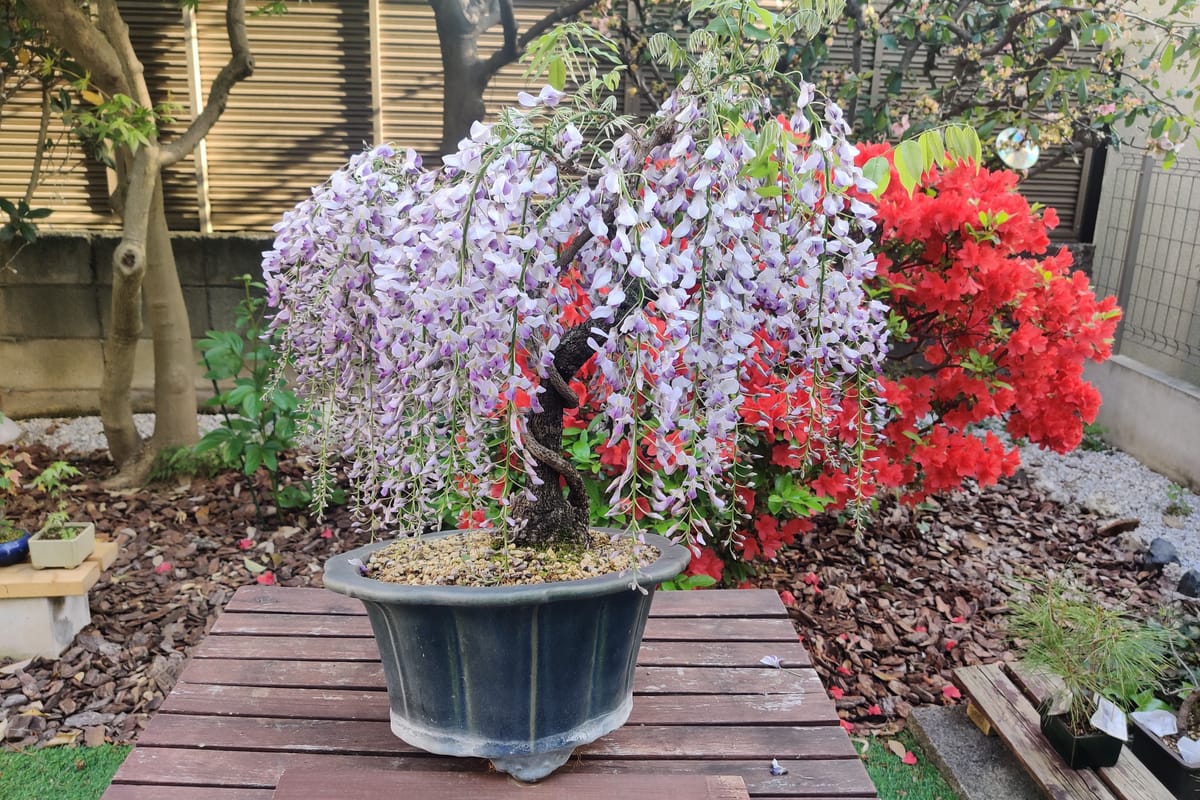
My wisteria, the one subscribers to my YouTube channel know, is the perfect example. When it flowers, the clusters are long, there are lots of them, and they smell wonderful. Every year, as soon as the clusters lengthened and the flowers opened, I brought it in to the middle of the living room table, or onto a chest of drawers. About two weeks. As soon as the flowers faded, I took it back out. It wasn’t as pretty any more, and above all, that’s when it grows its leaves: it needs light to get its strength back and set up the rest of the year. The plant gives the signal, both ways.
In Japan you see a lot of trees in homes, shops and restaurants. They’re works of art: they say something about the place, respect for nature, calm, precision. But they never stay long. Professionals rotate them: in a shop that wants a tree all year round, someone comes to swap it every two weeks at most. The customer who drops by every ten days thinks they’re seeing the same tree. They’re seeing a new one each time.
I got a bonsai for Christmas: what now?
A warning first: everything depends on the species, the season and the state of the tree. This advice is a starting point, not a hard rule.
First, water it. Trees sold outside specialist shops have often been badly watered, and planted in soil that doesn’t suit them.
Then give it light. If the tree has to stay indoors, put it in front of a window.
Keep it away from radiators and air conditioning. A radiator underneath or a draught blowing at it dries out the soil in the pot, then the roots, and the tree dies. It needs an airy, bright spot where you can easily touch the soil to see whether it needs water.
The trap is the corner of the living room table. After a few days the tree drops its leaves or starts to dry out. It has just changed environment, it isn’t acclimatised, and these trees are often small, so fragile.
If it’s an outdoor tree, the priority is to put it outside, as long as it isn’t freezing. In winter it’s already dormant. If it’s freezing, when in doubt, keep it indoors in a room that isn’t too warm, and keep a close eye on the soil: it dries out fast.
And put it where you’ll see it every day. What you want is to build a daily relationship with the tree, as you would with a pet.
How do you water a bonsai?
The basic rule: roots need to drink, and to breathe.
Water the whole root ball until water runs out of the holes under the pot. Then let it dry until the surface of the soil is dry, not all the way through. Only then water again. It’s that rhythm, repeated, that lets the roots drink, find air, and grow.
Roots that are always soaked suffocate and rot. Roots that are always dry dry out and die.
To know where the soil is at, nothing beats a finger. My trees are my morning ritual, with coffee. I go out, put a finger on the soil, check whether it’s dry, look for pests, look at them, and talk to them. A few seconds per tree. For fifteen or so trees, five to ten minutes a day.
My bonsai is dropping its leaves: can it be saved?
It’s the question I hear most in January: “Can I save it? It’s dropping its leaves. What should I do?”
There’s no magic answer. To diagnose it, you need to know the species, where it’s placed, how often it’s been watered, whether it has insects or pests, and when it was last repotted. Best is to see the tree, or at least a photo.
Then you act. Sometimes it’s enough to dip the pot briefly in a basin of water to rehydrate the whole root ball, then watch the tree closely for a few weeks. Sometimes you have to accept that the tree is already dead.
It all depends on the species. A ficus stressed by too little or too much water drops its leaves right away, and it can recover if you react in time. A pine that turns completely brown, as a rule, is past saving: it had already been dead for weeks, even months. Its needles yellow and fall long afterwards, when nothing can be done any more. Some species grow new leaves in the same season, others don’t. On some, a bare branch is dead. On others, it has just lost its leaves, and its buds will come back next year if you do what’s needed.
Bonsai is horticulture. You have to look at each case.
One thing, though, changes everything. When people receive a tree, their first question is: “How do I not kill it?” They start from the idea that the tree is going to die. The right question is: “How do I help it live at its best?” A tree isn’t meant to die. It’s meant to stay healthy for as long as possible.
Can I have a bonsai without a garden or balcony?
Yes. In a flat with no outdoor space, choose an indoor tree that will stay with you all year. They’re often evergreens: they look much the same all year round.
If you want to live the seasons, with outdoor trees that change through the year, there’s another way: rotation. Either you rent trees, for example one tree for two weeks, four times a year. Or your own trees are kept outside by a professional, who brings them to you regularly, in turn.
That’s what our collective in France does, starting now: we agree together on the number of rotations a year and the species you like, and set the system up.
Which bonsai should I give?
I start by asking where the tree will live: in a garden, or in a flat? That’s what decides it.
I also ask whether the person has a pet. It means they’re already used to looking after something alive, every day. A bonsai is like a cat or a dog: you have to look at it every day, give it water, give it food. Someone who says they have green fingers because their orchids do well isn’t the same thing.
”I’ve had bonsai, but they all died”
That’s sad, of course. But it’s good to have tried more than once. It’s like learning to draw, to write or to walk: you fall, you get up, you start again. Doing bonsai means accepting that some trees will die, because you didn’t do what was needed. You get another one, you correct, and you carry on.
The real question is: why did they die? If it’s the same reason every time, it isn’t the tree that needs changing, it’s a habit. Someone who tells me “yes, but I don’t water them” doesn’t need a new tree. They need to get into the habit of watering.
It’s no harder than having a pet. A coffee, a finger in the soil, a few seconds per tree. Every morning.
Questions
- Can a bonsai live indoors?
- Tropical species, like ficus, can live indoors most of the year in Europe. Japanese trees, like maples, pines and junipers, have to live outside.
- How long can a bonsai stay indoors?
- For an outdoor tree, never more than two weeks in a row. The most I'd recommend is ten weeks out, two weeks in. An evening now and then is no problem.
- My bonsai is dropping its leaves. What should I do?
- Feel the soil: too dry or waterlogged? If it's dry, dip the pot briefly in a basin of water. Put the tree in good light, away from radiators, and watch it for a few weeks. The diagnosis depends on the species: show a photo to a professional.
- How do you water a bonsai?
- Water the whole root ball until water runs out of the holes in the pot. Then wait until the surface of the soil is dry before watering again. Roots need to drink, and to breathe.
- Can I have a bonsai without a garden or balcony?
- Yes, by choosing an indoor species, like a ficus. To enjoy the seasons with outdoor trees, there's rotation: a tree comes to your home for two weeks, several times a year, then goes back to a professional.
- Which bonsai should I give as a Christmas present?
- First ask where the tree will live. For a flat with no outdoor space, an indoor tree. For a house with a garden, an outdoor tree.